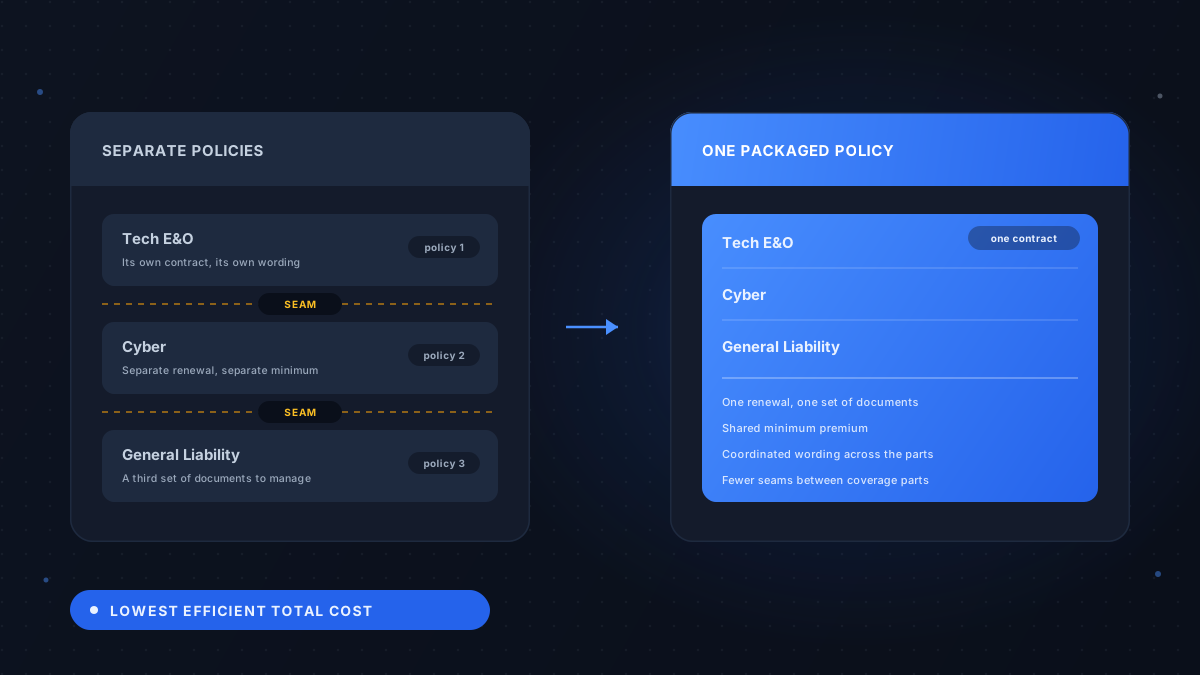
The biggest savings usually come from two things: using a broker to create competition across the right carriers, and packaging compatible coverages where it makes economic sense. A good broker can compare markets, knows which carriers are likely to want the risk, negotiates the terms, and structures the program as a whole. The goal is not simply the lowest premium, but the best coverage for the lowest efficient total cost.
The short answer: two ways startups can lower insurance costs
-
Create competition. Let a broker compare and negotiate across the carriers that actually fit your risk, rather than accepting one market's price.
-
Package related coverages. Combine lines such as Tech E&O and Cyber, or D&O, EPLI, and Fiduciary, when the carrier structure makes that more efficient.
The rest of this guide explains each lever and, just as important, when each one does not apply.
Why a broker can save you money
Insurance does not have one universal market price. The same company can get materially different quotes from different carriers, because each carrier has its own appetite, its own view of your industry and stage, and its own pricing model. One carrier might want your risk and price it keenly; another might not want it and price it high to compensate.
A broker's job is to find the carriers most likely to want your risk and put them in competition. In practice that means the broker can:
- compare competing terms across several carriers at once,
- present your company the way underwriters want to see it,
- and negotiate not just premium, but retention, limits, exclusions, and endorsements.
The key idea: one carrier gives you one view of your risk. A broker can create competition among the carriers most likely to want it.
Why carrier relationships and market knowledge matter
This is not "relationships guarantee cheaper pricing." It is more specific than that. An experienced broker already understands which carriers have appetite for a given startup, what each one's underwriting requires, and who is likely to compete for the business. That knowledge means better carrier selection, a better-presented submission, and far less wasted time, which is often where the real cost of buying insurance hides.
The second lever: package compatible coverages
Packaging means writing related coverages together, on one policy or as one coordinated program, instead of as separate contracts. For startups, two structures matter most:
-
Technology: Tech E&O and Cyber, and sometimes General Liability. A single software incident often triggers both Tech E&O and Cyber at once, so writing them together keeps the two coverages responding as one instead of arguing over which applies.
-
Management liability: D&O, EPLI, and Fiduciary. These three make up what the industry calls management liability; they overlap heavily in who they protect and how claims arise, so they are commonly written together (fiduciary liability becomes relevant once you run a 401(k) or benefit plan).
Why packaging can reduce total cost
When compatible coverages are written together, you can benefit from:
- shared minimum premiums instead of one per policy,
- fewer standalone policies to buy,
- lower administrative friction (one renewal, one set of documents, one point of contact),
- coordinated wording across the related coverages,
- and fewer potential seams between related coverage parts where a claim could fall.
Keep this conditional: packaging can reduce cost. It does not automatically do so, and the right structure depends on your carriers and risk profile.
When NOT to package
Packaging is a default worth testing, not a rule. A broker should separate a line when another carrier offers materially better wording, limits, exclusions, or pricing on that line on its own. Sometimes two policies at $5,500 total are the better deal than one $5,000 package, because the coverage is materially stronger where it counts. Saving money without cutting coverage sometimes means spending a little more on the line that matters.
Compare the whole program, not the cheapest quote
The lowest premium is not the same as the lowest cost. The real economic comparison is the whole program:
premium + retention + limits + exclusions + coverage gaps + administration.
A cheaper premium that comes with a higher retention, thinner limits, or a critical exclusion can cost far more the one time you have a claim. Comparing programs this way is how you lower cost without quietly cutting coverage.
How RiskCube approaches it
RiskCube first identifies your risks and your contractual insurance requirements. Then we determine which carriers are most likely to compete for the business, compare and negotiate the terms, and decide which coverages should be packaged and which should stay separate. You get one coordinated proposal built around best coverage for the lowest efficient total cost, not a stack of unrelated quotes.
Frequently Asked Questions
How does a broker actually lower my insurance cost?
By creating competition. Instead of accepting one carrier's price, a broker takes your risk to the carriers most likely to want it, compares their terms, and negotiates premium, retention, limits, exclusions, and endorsements. Because carriers price the same company differently based on appetite, that competition is often where the largest savings come from, before any packaging.
Is it cheaper to bundle business insurance?
Often, yes. Writing related coverages together on one policy spreads underwriting costs and minimum premiums across the bundle, so the total is frequently lower than buying each line separately. The savings depend on your carrier and risk profile, so it is a common result rather than a guarantee.
What is management liability insurance?
Management liability insurance is an umbrella category whose core lines are directors and officers (D&O), employment practices liability (EPLI), and fiduciary liability. D&O protects leadership and the company from claims about how the business is run; EPLI covers employee claims like wrongful termination, discrimination, and harassment; fiduciary liability covers the administration of benefit plans. For many early-stage startups, D&O and EPLI are packaged together as the common starting point, with fiduciary liability added once the company runs a 401(k) or benefit plan.
Can I combine cyber and tech E&O insurance?
Yes. Many carriers write technology errors and omissions and cyber liability on one combined form, so that when a single incident triggers both, the coverages respond together instead of disputing which one applies.
Is bundling only for early-stage companies?
Bundling is the best starting point for most early-stage companies because it is simpler and usually cheaper. As a company grows and needs higher limits or more specialized terms, individual coverages can be broken out and tailored. Starting bundled does not prevent unbundling later.
Does one packaged policy leave me underinsured?
Not if it is structured correctly. A well-built package carries appropriate limits for each coverage; it simply writes related coverages together instead of as separate contracts. The goal is fewer gaps, not less protection.
Best Coverage for the Lowest Efficient Total Cost
RiskCube puts the carriers most likely to want your risk in competition, then decides which coverages to package and which to keep separate, including coordinated Tech E&O, Cyber, and D&O programs.
Keep reading

Subcontractor Insurance Requirements: The Complete Guide
Subcontractor insurance requirements explained: the core coverages, endorsements, and AM Best carrier rating you need to sell to a large contractor.

Federal Contract Insurance Checklist (2026)
Government contractor insurance: required coverages, FAR limits, endorsements, Defense Base Act, AM Best ratings, and mistakes that delay starts.

About the author
Andrei Craciunescu
Founder & CEO, RiskCube · CA License #4467994
LinkedIn ProfileAndrei previously worked in the Risk & Analytics division of WTW (Willis Towers Watson), one of the world's largest insurance brokers and a recognized leader in AI, space, and defense risk. He holds an M.Sc. in Mathematics from LMU Munich and conducted PhD-level research in financial mathematics, including directors and officers (D&O) insurance, at the Technical University of Munich (TUM). His work applies AI and risk analytics to translate complex exposures into actionable insurance coverage decisions for VC-backed startups and small-to-medium businesses across the U.S.