Key takeaways
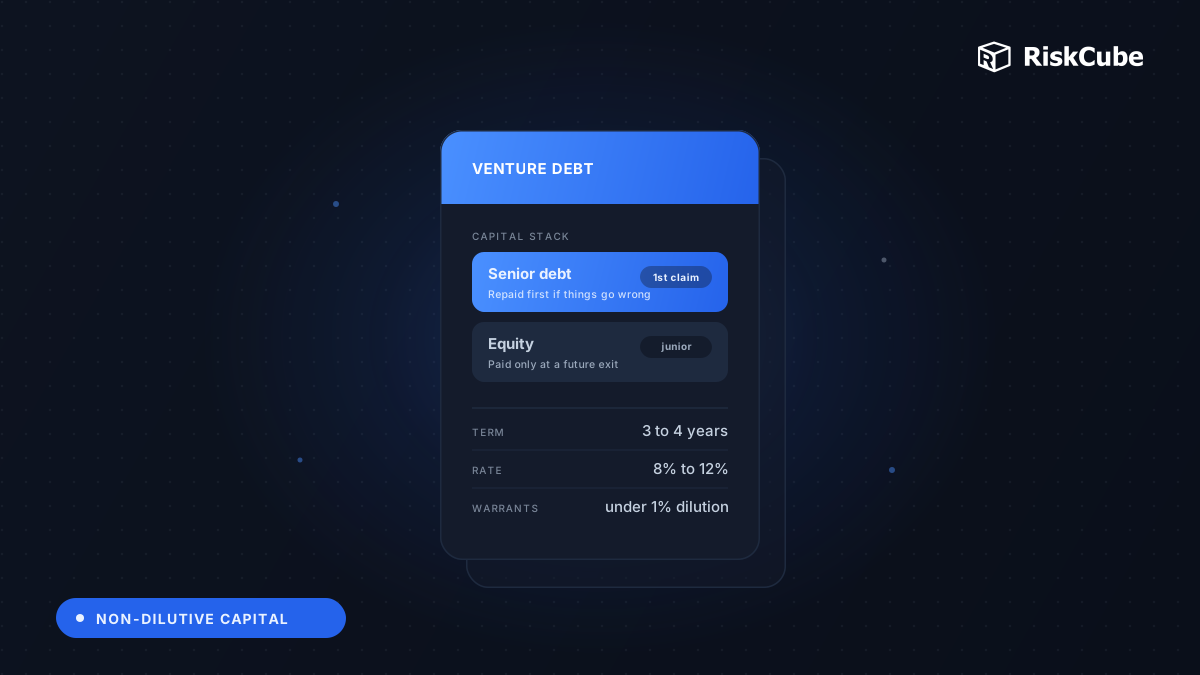
- Venture debt is a loan for venture-backed startups that funds growth or extends runway with far less dilution than raising equity.
- It follows equity, it does not replace it: lenders rely on your VC backing, and they sit senior to shareholders if the company winds down.
- Typical terms: 20% to 35% of your last round, a 3- to 4-year term, roughly 8% to 12% interest, warrants adding under 1% dilution, plus covenants.
- The two most common uses are extending runway to your next round and funding a bolt-on acquisition.
- Loan agreements carry insurance covenants (key person, additional insured, lender loss payee). A lapse alone, not a claim, can put you in breach.
You closed your round. The board is happy. But you can see the next raise coming, and you would rather hit it from a position of strength than start pitching again in nine months with the same metrics.
Or the opposite problem: a smaller competitor is for sale, buying them would pull forward your roadmap by a year, and you do not want to sell 8% of your company to fund a deal that debt could cover.
Both are classic reasons founders raise venture debt. Used well, it buys time and funds growth without giving up more ownership. Used poorly, it adds a fixed repayment obligation precisely when a company can least afford one. This guide explains what venture debt is, how it works, the two most common ways to use it, and the part most founders miss until closing day: the insurance your lender will require you to carry.
What Is Venture Debt?
Venture debt is a loan built for venture-backed startups. It is offered by specialist banks and non-bank lenders to fast-growing, usually pre-profit companies that have already raised equity from institutional investors.
The defining feature is simple: it is debt, not equity. You borrow money and pay it back with interest on a set schedule, rather than selling shares. As Silicon Valley Bank puts it, the first rule of venture debt is that "it follows equity; it doesn't replace it." Lenders use your existing VC backing as the primary signal that you are a reasonable credit risk, so venture debt sits alongside an equity round rather than substituting for one.
How venture debt differs from equity
-
It must be repaid. With equity, a future liquidity event is expected but not contractually required. Venture debt has to be repaid on its agreed schedule, whatever happens to the business (HSBC Innovation Banking).
-
It is far less dilutive. You give up a small slice of equity through warrants (more on those below) instead of issuing a full new round of shares.
-
It is senior to equity. As a16z notes, "debt is not a replacement for equity." Lenders sit ahead of shareholders in the capital structure and have first claim on company assets if things go wrong.
That trade is the whole point: typically less dilutive and often lower-cost than raising additional equity, but it comes with a repayment obligation and a lender who has priority if the company struggles.
How Does Venture Debt Work?
Most venture debt is structured as a growth-capital term loan: you draw a lump sum and repay it over a fixed period. Some lenders also offer revolving or asset-based lines drawn against receivables, inventory, or future billings (TriplePoint). The typical terms:
| Term | What to expect |
|---|---|
| Loan size | Usually 20% to 35% of your most recent equity round. SVB cites 25% to 35%; Kruze cites 20% to 35%; a16z puts it around 30% of the equity raised. A $10M round tends to support roughly $2M to $3.5M. |
| Term | Commonly three to four years (36 to 48 months). |
| Interest-only period | Most facilities start with a 6- to 12-month interest-only window, during which you pay only interest before principal repayment begins. This is what stretches near-term runway. |
| Interest rate | Typically a floating base rate (such as Prime) plus a spread, landing around 8% to 12%, higher than a traditional bank loan because the risk is higher (Kruze). |
| Fees | An origination/commitment fee (commonly around 0.5% to 2%) is standard, and many facilities also carry an end-of-term or final-payment fee due at maturity. Ask for the all-in cost, not just the headline rate. |
Warrants
Venture lenders take warrants, which are the right to buy a small amount of your equity later, usually at the price per share of your last round. Warrants give lenders additional upside and can enhance the return on the loan (Hercules; TriplePoint). Warrant coverage is quoted as a small percentage of the loan amount and is negotiable. Priced at your last round, it typically adds well under 1% of dilution to your cap table (a16z; Kruze), a fraction of what a new equity round would cost you.
Covenants
Loan agreements include covenants: conditions you have to keep to stay in good standing. Common ones include a minimum cash/liquidity requirement (a floor on the cash in your accounts), reporting obligations, sometimes a revenue or burn covenant, and a Material Adverse Change (MAC) clause. Breaching a covenant can put you in default and, in the worst case, let the lender accelerate the loan (demand full repayment). Bank lenders also frequently require you to hold your operating accounts with them (a deposit or banking-relationship covenant). And, as covered below, venture debt agreements commonly require you to maintain specified insurance coverage (Kruze).
Who lends it, and when to raise it
There are two camps:
-
Banks and innovation banks (Silicon Valley Bank, HSBC Innovation Banking): usually cheaper, but with more covenants and a requirement to bank with them.
-
Non-bank / specialty lenders and BDCs (Hercules Capital, TriplePoint, Trinity Capital): often more flexible with fewer covenants, at a somewhat higher cost.
One of the strongest times to raise venture debt is shortly after closing an equity round, when your cash balance and negotiating leverage are strongest and you still have 12+ months of runway. It is generally aimed at Series A, B, and C companies that are growing fast but not yet profitable, and is not widely available at the seed stage (SVB; Kruze; HSBC).
According to PitchBook-NVCA Venture Monitor data, US venture debt reached a record of roughly $53 billion in 2024 as the rising cost of equity pushed more founders toward debt. Which brings us to the two most common reasons founders raise it.
Use Case 1: Extending Runway to Raise Your Next Round
This is the classic use of venture debt: buy more time to hit the milestones that support a higher valuation, without selling more equity today.
The mechanics are straightforward. Venture debt is borrowed capital, so it funds your plan without issuing new shares, which "helps preserve founder and employee ownership" (Kruze). Because it usually starts with an interest-only period, it adds cash now while delaying principal repayment. Depending on the lender and the size of the facility, that typically buys several months to a year of extra runway (SVB cites three to nine months; Kruze cites six to twelve). That is often enough to reach a product launch, a revenue target, or a market milestone before you raise again.
The strategic payoff is on the next round
-
Higher valuation, less dilution. Extra runway lets you raise the next round from a stronger position, which can help you raise at a higher valuation and reduce dilution compared with raising now.
-
A bridge past a bad market. In a tough fundraising environment, venture debt can be a bridge that helps you avoid a down round or an emergency raise, so you set your next price from strength rather than desperation (Kruze).
The risks you cannot ignore
-
You have to repay it regardless. SVB is blunt: with venture debt "you do actually have to pay it back someday, and that day may turn out to be an inconvenient day." Underwriting leans on your ability to raise your next round, so repayment quietly depends on that round closing.
-
Debt does not add its full face value to runway. Once the interest-only period ends and amortization begins, principal payments start eating into cash. A burning company paying down principal is spending equity dollars on debt service, so $1M of debt at a $150K monthly burn adds fewer months than the headline math suggests.
-
Extend, do not rescue. Venture debt should extend a healthy trajectory, not rescue a broken one. Hercules frames venture debt as "non-dilutive capital that extends your runway," best for companies with product-market fit and growth, not struggling ones. Kruze warns it is unsuitable for "businesses already struggling to meet existing obligations." Venture debt tends to amplify the trajectory you are already on.
A useful stress test
Before you sign, model a meaningful downside case, for example revenue materially below plan and a delayed next financing round. If the company can still service the debt in that scenario, the facility is much more resilient. If that downside could leave the company unable to service the debt, the facility may be too large.
Use Case 2: Acquiring Another Business
Debt is a common way to fund an acquisition, and venture debt is no exception. SVB explicitly lists "funding for acquisitions" among the core uses of venture debt. For a growth-stage startup, the appeal is the same as always: buy a company without selling more of your own.
Why use debt instead of equity or cash for a deal
-
No extra dilution. You preserve founder, employee, and investor ownership instead of issuing new shares to fund the purchase (Corporate Finance Institute).
-
Often the cheapest capital in the deal. Equity can be significantly more expensive in terms of ownership dilution. Debt typically avoids most of that dilution, although interest, fees, warrants, and repayment risk still need to be considered. Interest may also be tax-deductible, though that benefit is limited and worth little if you are still pre-profit.
-
Speed. Debt can sometimes be arranged faster than a full equity round, which matters when an acquisition has a timeline (HSBC).
-
Keep cash for operations. Financing the deal lets you hold onto cash to keep running and growing the combined business.
Most startup acquisitions are bolt-on (or tuck-in) deals: buying a smaller company with complementary technology, customers, or geography and folding it into your business. These are less capital-intensive than a large merger and are a natural fit for debt (CFI).
Why this matters more in the AI era. As product development becomes faster and more commoditized, distribution can become an increasingly important moat: the customers, channels, and market access that are hard to replicate. Buying a company for its distribution may be faster than building that reach from scratch, and venture debt can help finance that acquisition without issuing a full new equity round.
How the debt is structured for an acquisition. Beyond a straight term loan, a common structure is a delayed-draw term loan (DDTL), a committed line you can draw later on pre-agreed terms once an acquisition actually materializes. As law firm Proskauer explains, in private credit a DDTL is usually labeled a "capex, CAF or acquisition facility," typically with a three- to four-year window to draw. You pay a small commitment ("ticking") fee on the undrawn amount until you use it.
What lenders check before funding a deal. Acquisition lenders look hard at the stability of cash flow, the collateral, customer concentration, management continuity, and above all the integration plan and execution risk (PCE Companies). Expect covenants tied to the combined business, and note that senior lenders may restrict earnout payments to the seller until the acquisition loan is partly or fully repaid.
The risks. Acquisition debt must be repaid on schedule regardless of how the deal performs, so a bad integration leaves you servicing debt on an asset that is not delivering. Leverage magnifies returns on the upside and losses on the downside, tightens your flexibility, and can constrain your ability to raise equity later (HSBC; CFI). Debt makes a good acquisition better and a bad one much worse.
When Venture Debt Is a Mistake
Venture debt is a tool, not free money. It is the wrong choice when:
- You are three to four months from running out of cash with no clear path to a raise. Debt will not save a company that is already out of runway; it just adds a creditor to the wind-down.
- Your fundamentals are deteriorating (churn rising, growth stalling, unit economics underwater). Debt amplifies the trend.
- There is no credible path to a next round or to profitability within the term of the loan.
- You are using it as a substitute for a hard fundraising conversation rather than an extension of a healthy plan.
Venture debt works best as an extension, not a rescue.
The Insurance Your Lender Will Require
Here is the part founders often discover at closing: venture debt agreements can contain detailed insurance covenants. Those requirements may become closing conditions and must remain satisfied throughout the term of the loan. Loan documents commonly require the borrower to maintain specified coverage, naming the lender, for the life of the loan (Arc). This is not boilerplate you can ignore. Failing to keep the required coverage in force is a covenant breach that can trigger default, even if nothing ever goes wrong operationally.
This is drawn straight from real loan agreements filed with the SEC:
1. Key person life insurance
Depending on the lender and the importance of particular founders or executives, the agreement may require key person life insurance on the founder(s) whose loss would put the loan at risk. The policy is owned by the company, and the lender takes a collateral assignment, meaning the death benefit repays the outstanding loan balance first, before any remainder goes to the business. Sample loan language requires the borrower to "maintain key person life insurance" of a stated amount and deliver a collateral assignment "in form and substance satisfactory to the Administrative Agent" within 30 to 60 days of closing (Law Insider sample clauses). The required amount is usually tied to the loan balance.
One practical trap: a life insurance policy insures a specific person. If your insured key person leaves and a successor takes over, you cannot simply move the coverage; you need a new policy on the new person, and the lender will require it to be re-assigned. Miss that, and you are out of compliance.
2. Liability and property insurance, with the lender named
Real venture debt agreements spell out exactly how the lender must appear on your policies:
-
A Hercules Capital loan and security agreement (filed with the SEC) requires the Agent to be named as an additional insured for commercial general liability and as a lender loss payee for all-risk property damage insurance, with certificates of insurance delivered, policy copies within 60 days, and at least 30 days' advance written notice of cancellation (10 days for non-payment) (SEC EDGAR).
-
A Silicon Valley Bank loan and security agreement requires property policies to show the Bank "as the sole lender loss payee" and waive subrogation, liability policies to show the Bank "as an additional insured," and at least 20 days' notice before any cancellation, with proceeds payable to the Bank at its option (SEC EDGAR).
3. D&O and other coverage
By the time you are raising venture debt you are typically post-Series A, where investors and boards already expect Directors & Officers (D&O) insurance in place, and lenders expect a complete, current business insurance program.
Why this is where deals get stuck
The insurance itself is not the hard part. Getting the exact endorsements the loan requires (additional insured, lender loss payee, waiver of subrogation), sized correctly, with the right cancellation-notice terms and carrier ratings, and then keeping every one of them in force through each renewal, is. As the loan agreements above make clear, if a required policy lapses, a required loss-payee endorsement drops off at renewal, or required key person coverage ends while the loan is outstanding, you may be in breach of the insurance covenant. The lapse, not a claim, is the event that hurts.
How RiskCube Helps
RiskCube places the coverage venture lenders require, and structures it to match your loan documents:
-
Key person life insurance on your founders, sized to the loan and set up for the lender's collateral assignment. See our key person life insurance page.
-
General liability and property coverage with the endorsements and evidence of insurance required by your loan documents: additional insured, lender loss payee, and waiver of subrogation.
-
D&O and a complete startup program placed with AM Best-rated carriers that meet lender and investor requirements.
-
Certificates of insurance issued fast so you can satisfy a closing condition on time. See our COI guide.
-
Ongoing review so your endorsements survive each renewal and you stay covenant-compliant for the life of the loan.
One application, 40+ carriers compared, and licensed broker review at every step, so the insurance side of your venture debt closing is the easy part.
Frequently Asked Questions
What is venture debt, in one sentence?
Venture debt is a loan for venture-backed startups that lets you fund growth or extend runway with far less dilution than raising equity, in exchange for interest, warrants, and a fixed repayment obligation.
How is venture debt different from venture capital?
Venture capital is equity: investors buy shares and are repaid only through a future exit. Venture debt is a loan that must be repaid on a schedule regardless of outcome, and the lender sits ahead of equity holders if the company winds down. Debt is typically less dilutive than equity, but it creates fixed repayment obligations that become more difficult to manage if your plan slips.
How much venture debt can a startup raise?
Typically 20% to 35% of your most recent equity round, so roughly $2M to $3.5M on a $10M round. Some lenders size it against your post-money valuation (around 6% to 8%) or, for later-stage companies, against recurring revenue.
What does venture debt cost?
Expect an interest rate around 8% to 12%, an origination fee, warrants (a small slice of equity priced at your last round), and often an end-of-term fee. Always ask for the all-in cost, not just the interest rate.
Can I use venture debt to acquire another company?
Yes. Funding acquisitions is a recognized use of venture debt, and it lets you buy a company without issuing new equity. For deals, lenders often use a delayed-draw or acquisition facility and will diligence the target and your integration plan closely.
What insurance do venture lenders require?
Requirements vary by lender and loan agreement. Common requirements can include property and general liability coverage, with the lender shown as additional insured or loss payee where applicable. Some lenders also require key person life insurance with a collateral assignment. Growth-stage companies may already carry D&O, cyber, Tech E&O, workers' compensation, and other coverage based on their operations. The key is to match the insurance program to the exact covenants in the loan documents and keep the required coverage in force throughout the term.
When should I not raise venture debt?
When you are nearly out of cash with no clear path to a raise, when your fundamentals are declining, or when you are using it to avoid a hard fundraising conversation. Venture debt extends a healthy plan; it does not rescue a failing one.
Make the Insurance Side of Your Raise the Easy Part
Raising venture debt? RiskCube places the key person, D&O, and liability coverage lenders require, structured to match your loan documents, with AM Best-rated carriers and a COI issued in as little as 24 hours.
Apply for a quote todayKeep reading
Subcontractor Insurance Requirements: The Complete Guide
Subcontractor insurance requirements explained: the core coverages, endorsements, and AM Best carrier rating you need to sell to a large contractor.
Federal Contract Insurance Checklist (2026)
Government contractor insurance: required coverages, FAR limits, endorsements, Defense Base Act, AM Best ratings, and mistakes that delay starts.

About the author
Andrei Craciunescu
Founder & CEO, RiskCube · CA License #4467994
LinkedIn ProfileAndrei previously worked in the Risk & Analytics division of WTW (Willis Towers Watson), one of the world's largest insurance brokers and a recognized leader in AI, space, and defense risk. He holds an M.Sc. in Mathematics from LMU Munich and conducted PhD-level research in financial mathematics, including directors and officers (D&O) insurance, at the Technical University of Munich (TUM). His work applies AI and risk analytics to translate complex exposures into actionable insurance coverage decisions for VC-backed startups and small-to-medium businesses across the U.S.