Key takeaways
- An AM Best rating measures an insurance carrier's financial strength, its ability to pay claims. It is a credit score for the insurer, not your policy.
- Most enterprise and government vendor contracts require a carrier rated A- (Excellent) or better; regulated industries often require A or A+.
- A policy placed with a non-rated carrier is routinely rejected by enterprise procurement, even if the limits are correct.
- Verify any carrier's rating free at ratings.ambest.com before you bind, and confirm the final policy carrier matches the rated entity.
You found coverage. The premium fits the budget. The policy limits match what the contract requires. You request the COI and send it over.
The enterprise client's procurement team rejects it.
The reason, buried in a one-line email: "We require coverage placed with an A.M. Best A-rated or better carrier."
This happens more often than it should, and it's entirely preventable. This guide explains what insurance carrier ratings are, why they matter, and how to make sure you're placed with a carrier that enterprise buyers, investors, and regulators will actually accept.
What is an insurance carrier rating?
Start here: a carrier rating is not about your policy. It's about the insurer.
An insurance carrier rating is an independent assessment of an insurance company's financial strength, its ability to pay claims when they come due. Think of it as a credit score for the insurer itself.
The most widely recognized rating agency in the U.S. insurance market is A.M. Best, which has evaluated insurer financial strength since 1899. When a vendor contract, investor, or government agency specifies a "rated carrier," they almost always mean A.M. Best specifically.
Other agencies (Moody's, S&P, Fitch) also rate insurers, but A.M. Best is the standard the insurance industry uses and the one you'll see referenced in vendor contracts.
The A.M. Best rating scale
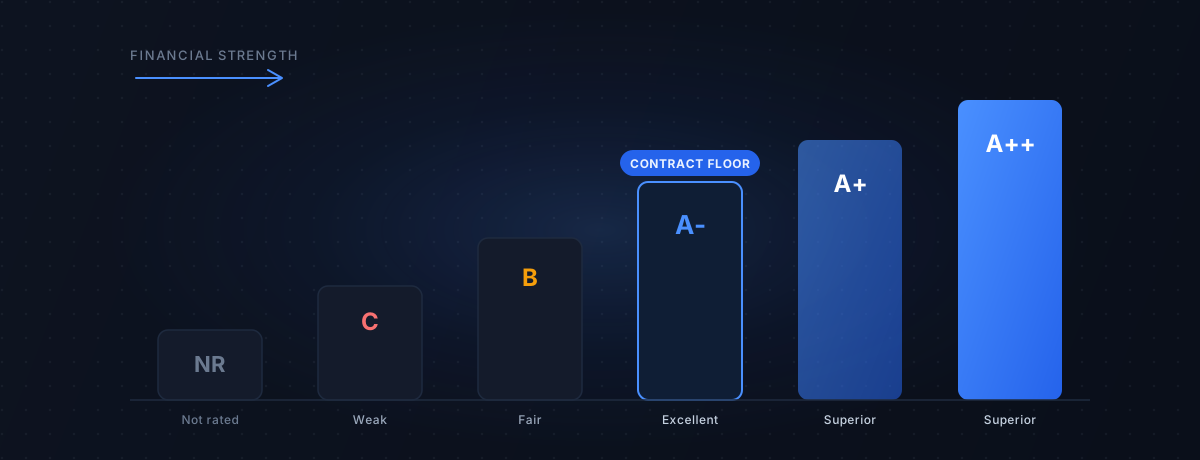
A.M. Best rates insurers on a letter scale. The grades that matter most for startup insurance:
| A.M. Best rating | Financial strength | What it means for you |
|---|---|---|
| A++ / A+ | Superior | Top-tier financial stability; accepted everywhere |
| A / A- | Excellent | The minimum most enterprise contracts require contract minimum |
| B++ / B+ | Good | Sometimes acceptable for smaller contracts; verify with the client |
| B / B- | Fair | Frequently rejected by enterprise procurement teams |
| C and below | Weak / Poor | Rarely accepted; high claims-payment risk |
| NR / Not Rated | Unrated | No A.M. Best assessment; rejected by most enterprise buyers |
The minimum threshold in most Fortune 500 and government vendor contracts is A- (Excellent). Some regulated industries (banking, healthcare, federal contracting) require A or better.
Why enterprise buyers require rated carriers
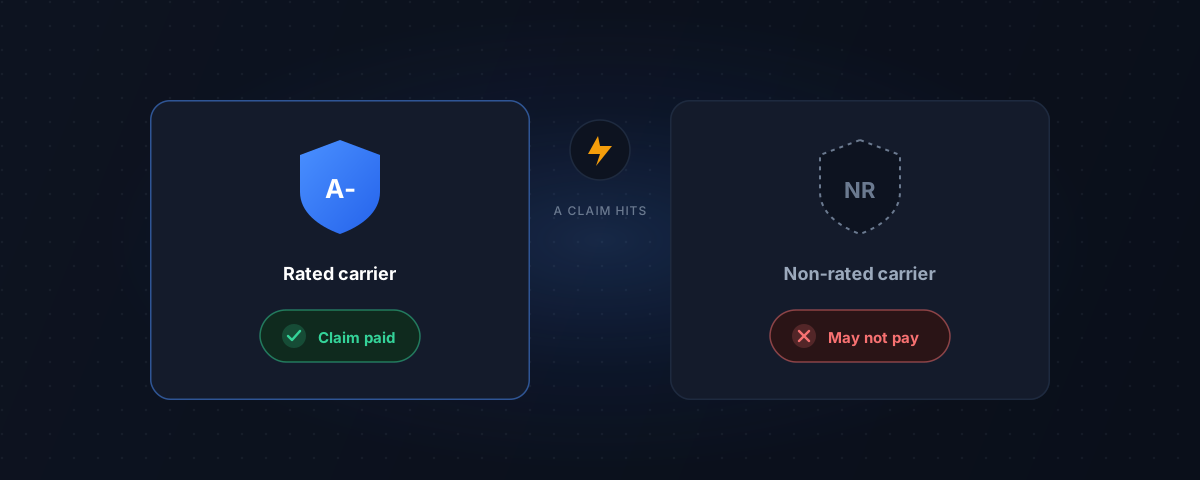
Procurement teams don't check your carrier's financials themselves. They let A.M. Best do it. When a contract specifies an A-rated carrier, that's the team outsourcing due diligence to an agency that has already done the work.
The logic is simple. If your company causes them a loss and your insurer goes insolvent before the claim is paid, the coverage is worthless, and they're exposed. A strong A.M. Best rating is their assurance that the carrier has the reserves to pay.
This matters more in certain industries:
-
Financial services and fintech: regulators and counterparties require carrier financial-strength documentation as part of third-party risk management programs.
-
Federal and defense contracting: FAR clauses often specify minimum carrier ratings; some agencies require A+.
-
Healthcare: HIPAA business associate agreements frequently require admitted, financially rated carriers.
-
Enterprise SaaS: Fortune 500 vendor contracts almost universally include a carrier-rating floor in the insurance exhibit.
Even when a contract doesn't specify a threshold, a non-rated or low-rated carrier creates risk: if the carrier is downgraded or becomes insolvent mid-term, your coverage could lapse and trigger a breach of the vendor agreement.
The 6 most common mistakes founders make when evaluating carrier quality
Assuming cheaper quotes come from equally strong carriers.
Premium differences often reflect the carrier's financial strength, not just pricing appetite. A quote 30% cheaper than comparable offerings may be from a surplus lines carrier without an A.M. Best rating. Always check the carrier name on any quote before binding.
Not checking the carrier name on the quote.
Founders focus on the premium and limits columns and skip who is actually issuing the policy. Before binding, look up the carrier's A.M. Best rating at ratings.ambest.com, a free public lookup.
Confusing the broker's reputation with the carrier's rating.
Your broker's credibility has nothing to do with the financial strength of the carrier they place you with. A reputable broker can still place you with a non-rated carrier if you don't ask. Verify the carrier independently.
Treating admitted and non-admitted carriers as equivalent.
An admitted carrier is licensed and regulated by your state's Department of Insurance. A surplus lines (non-admitted) carrier operates outside standard state regulation. Non-admitted carriers aren't necessarily unrated (many carry strong A.M. Best ratings), but if an admitted carrier becomes insolvent, state guarantee funds offer limited protection; surplus lines policies are not covered by those funds.
Not verifying the rating is current.
A.M. Best ratings change. A carrier that was A-rated when you bound may be downgraded during the term. Check the rating at renewal, and monitor for changes if you're in a high-scrutiny industry.
Assuming the rating on the binder matches the final policy carrier.
Some policies are bound with one carrier and then transferred or layered with another on the final policy. The carrier named on your COI is the one that needs to be rated. Confirm the final policy carrier matches the rated entity before requesting the COI.
Industry-specific guidance
AI and software startups
Enterprise MSAs increasingly include carrier-rating requirements in the Tech E&O and Cyber sections, often A- or better. If your product processes customer data or has SLA commitments, assume buyers will check.
Space and defense
Federal contracting requirements are among the most stringent. FAR 28.307-2 and related clauses specify carrier financial-strength requirements, and surplus lines carriers, even rated ones, are sometimes excluded in favor of admitted markets. Work with a broker who has placed prime and sub-contractor coverage.
Fintech and financial services
Banking regulators and financial-institution counterparties run third-party risk programs that evaluate your insurer's ratings during vendor onboarding, often alongside your SOC 2 and penetration-test results.
Web3 and crypto
The admitted market for digital-asset companies is limited, so many placements use surplus lines carriers. Verify the A.M. Best rating for any surplus lines carrier proposed; several reputable ones carry A or better despite operating in the non-admitted market.
How to verify your carrier's A.M. Best rating
Go to ratings.ambest.com, where the lookup is free and public.
Search by the carrier's exact legal name (it appears on your policy declarations page).
Look for the Financial Strength Rating (FSR), the A++ through D scale.
Check the Outlook (Stable, Positive, or Negative), not just the current letter grade.
Note the effective date of the rating and confirm it is current.
If the carrier doesn't appear in the A.M. Best database, it is either unrated or listed under a different legal entity name. Ask your broker for the A.M. Best AMB# (the unique identifier assigned to each rated entity) if you can't find it by name.
How RiskCube handles carrier quality
Every policy RiskCube places is with an A.M. Best-rated carrier. We work only with carriers that clear the financial-strength thresholds enterprise contracts, investors, and regulated-industry buyers require.
Ready to compare A-rated carriers? Start with your coverage →
Frequently asked questions
What is the minimum A.M. Best rating most vendor contracts require?
Most Fortune 500 and enterprise vendor contracts require A- (Excellent) or better. Federal government contracts and regulated industries (banking, healthcare, defense) often require A (Excellent) or A+ (Superior). Always check the insurance exhibit in your specific contract; it will state the requirement explicitly if one exists.
Can a non-rated carrier ever be acceptable?
Occasionally, for very specific coverage types in niche markets where rated capacity doesn't exist. But for standard startup lines (General Liability, Tech E&O, Cyber, D&O), there is no reason to accept a non-rated carrier. Rated options are available at competitive prices in all of these lines.
What happens if my carrier's rating drops during my policy term?
Your coverage remains in force; a downgrade doesn't void the policy. But your vendor contract may require you to maintain coverage with a carrier meeting the stated threshold, which could mean re-placing coverage mid-term if the carrier drops below it. Your broker should notify you of material rating changes.
Is a surplus lines carrier always lower quality than an admitted carrier?
No. Many of the strongest carriers in specialty lines operate as surplus lines (non-admitted) carriers because certain risks don't fit standard admitted markets. A surplus lines carrier with an A.M. Best A rating is financially stronger than an admitted carrier with a B+ rating. The admitted/non-admitted distinction affects state regulation and guarantee-fund protection, not necessarily financial strength.
What does "admitted" mean on a certificate of insurance?
A COI doesn't typically state whether a carrier is admitted or non-admitted; that's on the policy declarations page. If a contract requires an admitted carrier specifically, ask your broker to confirm the carrier's admitted status in your state before binding.
Get coverage from A-rated carriers in 24 hours
RiskCube places startup insurance exclusively with A.M. Best-rated carriers that meet enterprise vendor-contract requirements. One application, 40+ rated carriers compared side by side, COI issued within 24 hours of binding.
Keep reading
Subcontractor Insurance Requirements: The Complete Guide
Subcontractor insurance requirements explained: the core coverages, endorsements, and AM Best carrier rating you need to sell to a large contractor.
Federal Contract Insurance Checklist (2026)
Government contractor insurance: required coverages, FAR limits, endorsements, Defense Base Act, AM Best ratings, and mistakes that delay starts.

About the author
Andrei Craciunescu
Founder & CEO, RiskCube · CA License #4467994
LinkedIn ProfileAndrei previously worked in the Risk & Analytics division of WTW (Willis Towers Watson), one of the world's largest insurance brokers and a recognized leader in AI, space, and defense risk. He holds an M.Sc. in Mathematics from LMU Munich and conducted PhD-level research in financial mathematics, including directors and officers (D&O) insurance, at the Technical University of Munich (TUM). His work applies AI and risk analytics to translate complex exposures into actionable insurance coverage decisions for VC-backed startups and small-to-medium businesses across the U.S.